OEM projects: integrating ventilation into your machine
Topics: Applications and Products
We start from a standard series and adapt it to the technical, construction and functional requirements of your equipment.
From standard series to your machine: custom industrial ventilation solutions
Not every machine needs the same fan. Each piece of equipment has its own requirements in terms of airflow, pressure, available space, operating conditions and mounting method. That is why choosing a “standard” model is not always enough: in many industrial projects, the answer is to adapt the fan to the specific characteristics of the application. It is not just a question of air.
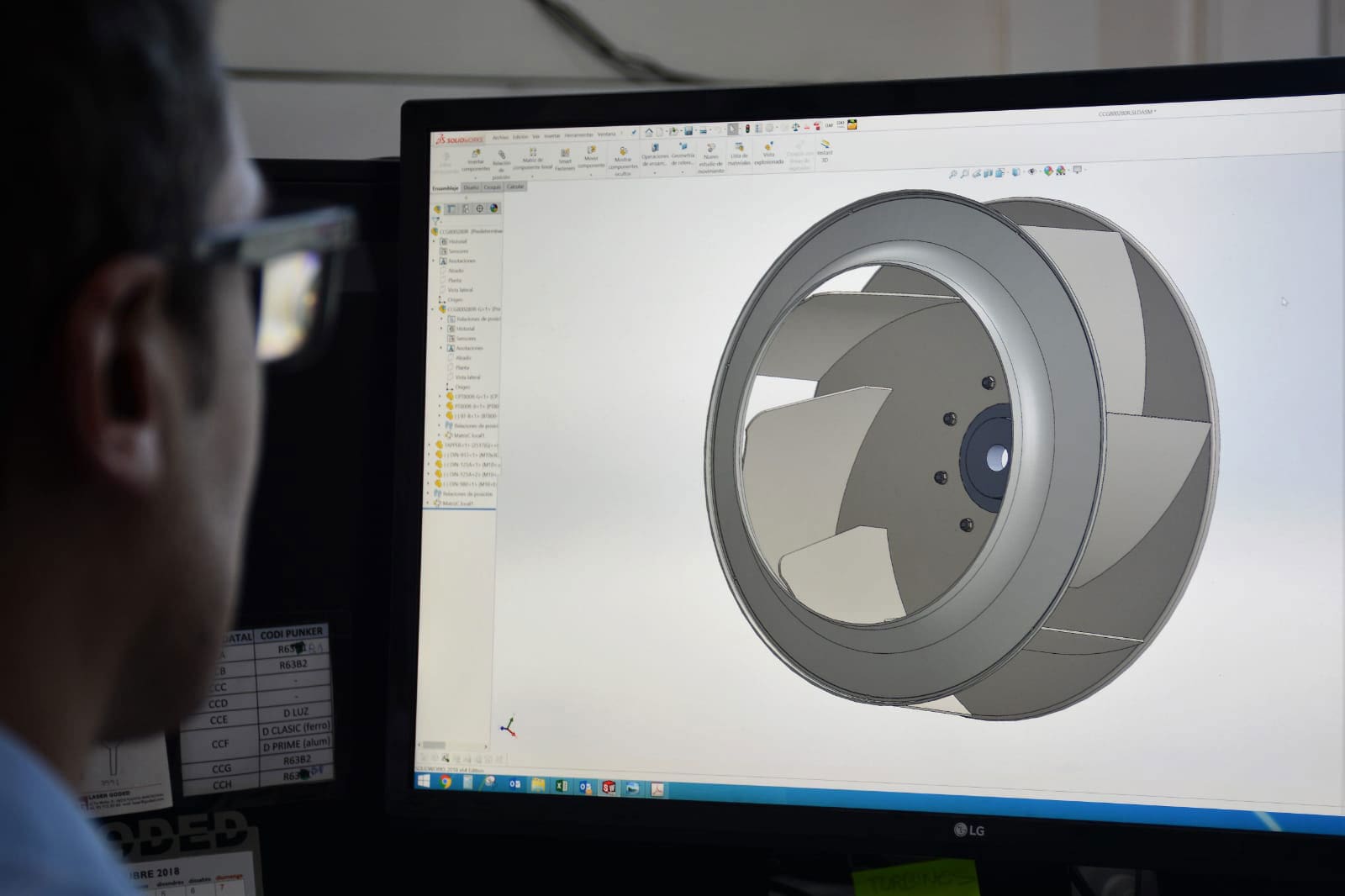
At SDT AIR we develop custom industrial ventilation solutions for machinery manufacturers, integrators and industrial companies. We start from a standard series when it is the most sensible option, and then adapt it to meet the technical requirements of each project, from aerodynamic performance to dimensions, fixings and the configuration of the assembly.
Our goal is for ventilation not to be something squeezed in at the last minute, but a functional part of the machine from the design phase, right from the very start.
Custom industrial fans: much more than choosing a model
When a manufacturer looks for an industrial fan, they are really looking for more than a piece of equipment that moves air. They need a system that works well inside their machine, fits their design and responds to real operating conditions. Not “maybe”, but reliably in everyday use.
A fan may show adequate performance on paper and still not be the best option if its dimensions complicate assembly, if its connections do not match those of the equipment, or if its configuration does not meet the needs of the application.
That is why, at SDT AIR, we approach each project from a complete perspective. We review the ventilation needs, identify the most suitable product family and study which adaptations can make integration cleaner and more efficient, with fewer last-minute adjustments.
Aspects we can assess include:
- Airflow: the volume of air the fan must move to meet the needs of the process.
- Operating pressure: the pressure it must deliver to overcome the pressure losses of the circuit or system.
- Dimensions and available space: the geometric constraints of the equipment where the fan will be installed.
- Mechanical configuration: the flanges, fixing points, orientation and interfaces required for mounting.
- Motor and drive: the configuration that best suits the operating requirements of the assembly.
- Operating conditions: factors such as temperature, environment and the characteristics of the application.
- Integration into the machine: compatibility with the other components and with the customer's manufacturing process.
This approach helps us choose and adjust a solution that makes sense for the assembly as a whole, rather than simply trying to find a fan with fixed nominal “performance” figures, the kind that are written down and set in stone.
From a standard series to a far more tailored OEM assembly
Every project starts differently. Sometimes a catalog model fits the application almost as is. Other times, changes are needed, whether small adjustments or larger ones, to achieve smoother integration.
What we do in customization is, in fact, start from a base series and review which adjustments are needed to bring the product in line with the manufacturer's requirements, logically and without forcing it.
1. We look at the application
The first step is to understand what the machine needs. We review airflow, pressure, the actual space where it will be mounted, the ambient conditions and the particular features of the system the fan will be coupled to.
The clearer the real-world use of the application, the more precisely the solution can be selected.
2. We choose the most consistent family
With the technical requirements on the table, we look for the product range that provides the most suitable starting point. The choice should reflect the intended operation, the available space and how the process behaves.
Starting from an existing series, where feasible, makes it possible to build on previous development work and focus the adjustment effort on what the project really needs.
3. We adapt the fan to your design
Once the starting solution is defined, it is time to study the modifications that will make integration easier. Depending on the case, aspects such as dimensions, flanges, orientation, fixings or even the motor configuration can be considered.
The extent of each customization is determined by the application and the technical feasibility of the requested changes, with no guesswork.
4. We prepare a solution designed to fit well
The ultimate goal is to deliver a ventilation component that fits the machine's design and also meets the defined requirements. This way, the manufacturer can rely on a solution conceived for their specific case, instead of having to resolve all the differences between the standard product and the finished equipment on their own.
At SDT AIR we don't treat customization as an “extra” added at the end. We see it rather as a way of bringing ventilation, step by step, closer to the real needs of each machine, which is ultimately what matters.
OEM ventilation solutions for machinery manufacturers
In this context, OEM (Original Equipment Manufacturer) refers to manufacturers that incorporate third-party components or systems into their own equipment.
For these manufacturers, selecting an industrial fan has implications that go beyond product performance. Mechanical integration, configuration repeatability and compatibility with the machine design are also relevant factors.
An OEM ventilation solution must meet the project specifications and make it easier to incorporate into the final equipment.
That is why SDT AIR takes an integration-oriented approach: we study the manufacturer's needs and look for the most suitable solution within our product range and our adaptation and custom manufacturing capabilities.
This approach is particularly relevant for:
- Industrial machinery manufacturers.
- Companies that design and manufacture special equipment.
- System and technical solution integrators.
- Agricultural machinery manufacturers.
- Companies that develop air conditioning and ventilation equipment.
- Manufacturers of air treatment installations and systems.
Collaborating from the early stages of the project helps to better define the ventilation requirements and assess integration needs before the machine design is finalized.
What are the benefits of a customized industrial fan?
Adapting a fan to a machine can add value at different stages of equipment development and manufacturing.
Better mechanical integration. Adapting dimensions, fixings and connections can make assembly easier and reduce incompatibilities with the machine design.
A solution tailored to the application. Selection is based on the actual airflow, pressure and operating requirements, rather than solely on the characteristics of a generic model.
Greater consistency in equipment design. Treating ventilation as part of the whole makes it possible to better match the component to the needs of the system.
Fewer improvised adaptations. Defining interfaces and integration requirements from the outset helps anticipate difficulties that might otherwise arise during assembly.
More direct technical collaboration. Working with a supplier specialized in customized solutions makes it easier to analyze needs and define a suitable proposal.
The specific benefits depend on each project. That is why customization must be based on a technical analysis that determines which modifications add value and which are truly necessary.
How do you choose the right industrial fan for your machine?
Before selecting a fan, it is advisable to gather the basic information about the application. This data helps guide the technical study and reduces uncertainty while the solution is being defined.
If you are developing a machine or need to adapt an existing system, we recommend preparing:
- Required airflow: the volume of air needed for the process.
- Operating pressure: the pressure the fan must deliver under the expected conditions.
- Available dimensions: the maximum space for installing the equipment.
- Mounting requirements: flanges, fixings, orientation and connections.
- Operating conditions: temperature, environment and air characteristics.
- Electrical and drive data: motor and power supply requirements, where applicable.
- Drawings or equipment information: documentation that shows how the fan will be integrated.
- Manufacturing needs: whether it is a single unit, a series of machines or a recurring supply project.
You don't need to have all the information at first contact. However, the more data you can provide, the easier it will be to assess the alternatives and define the scope of the adaptation.
SDT AIR: your partner in custom industrial ventilation solutions
At SDT AIR we combine technical knowledge, industrial experience and customization capabilities to develop ventilation solutions adapted to different applications.
Our work ranges from selecting products from our range to studying modifications and customized solutions to meet the customer's needs.
We work to ensure that the fan is not an isolated element, but a component that meets the requirements of the system it is built into. To do this, we focus on analyzing the application, defining the technical characteristics and collaborating with the manufacturer throughout the development of the solution.
If you are looking for an industrial fan manufacturer able to study the needs of your project, SDT AIR can help you assess the available options and adaptation possibilities.
From standard series to your machine: we turn your ventilation needs into a solution designed for your application.
Need a custom industrial fan?
Tell us what you are manufacturing, what your airflow and pressure requirements are and how the fan needs to be integrated into your equipment.
The SDT AIR team will study the application's needs with you to identify the most suitable ventilation solution.